

Fortress Fencing Team · September 10, 2026 · 6 min read
What Actually Keeps a Fence Standing in a Metro Vancouver Windstorm
A practical comparison of wood, vinyl, and aluminum fencing for exposed properties from Tsawwassen to the Fraser Valley, plus the installation details that actually keep a fence standing.
Why wind matters more in some Metro Vancouver neighbourhoods
Metro Vancouver doesn’t have one wind climate, it has several. Most of the year the region sees moderate westerly and southwesterly winds off the Strait of Georgia, manageable for a standard fence. Two other patterns are worth planning around.
The first is coastal exposure. Waterfront communities such as Tsawwassen, White Rock, and Point Grey have little to slow the wind before it reaches a backyard fence line, so gusts off Boundary Bay, Semiahmoo Bay, and the Strait of Georgia arrive close to full strength.
The second is outflow wind. In late fall and winter, cold air draining from the BC Interior funnels through the Fraser Canyon and across the Fraser Valley, picking up speed through Hope, Chilliwack, Abbotsford, and Langley. These events can hit with little warning, which is why Environment Canada regularly issues wind warnings for this corridor in winter.
If your property sits in one of these zones, wind is a design input, right alongside privacy, budget, and curb appeal.
Outflow winds through the Fraser Valley are driven by cold air draining from the Interior, distinct from coastal gusts hitting Tsawwassen, White Rock, and Point Grey. A fence built for one won’t automatically stand up to the other.
How wood, vinyl, and aluminum actually handle wind
Think of a fence panel as a sail. The more solid surface area it presents, the more force gets transferred into the posts and footings. That explains most of the difference between wood, vinyl, and aluminum in a windstorm.
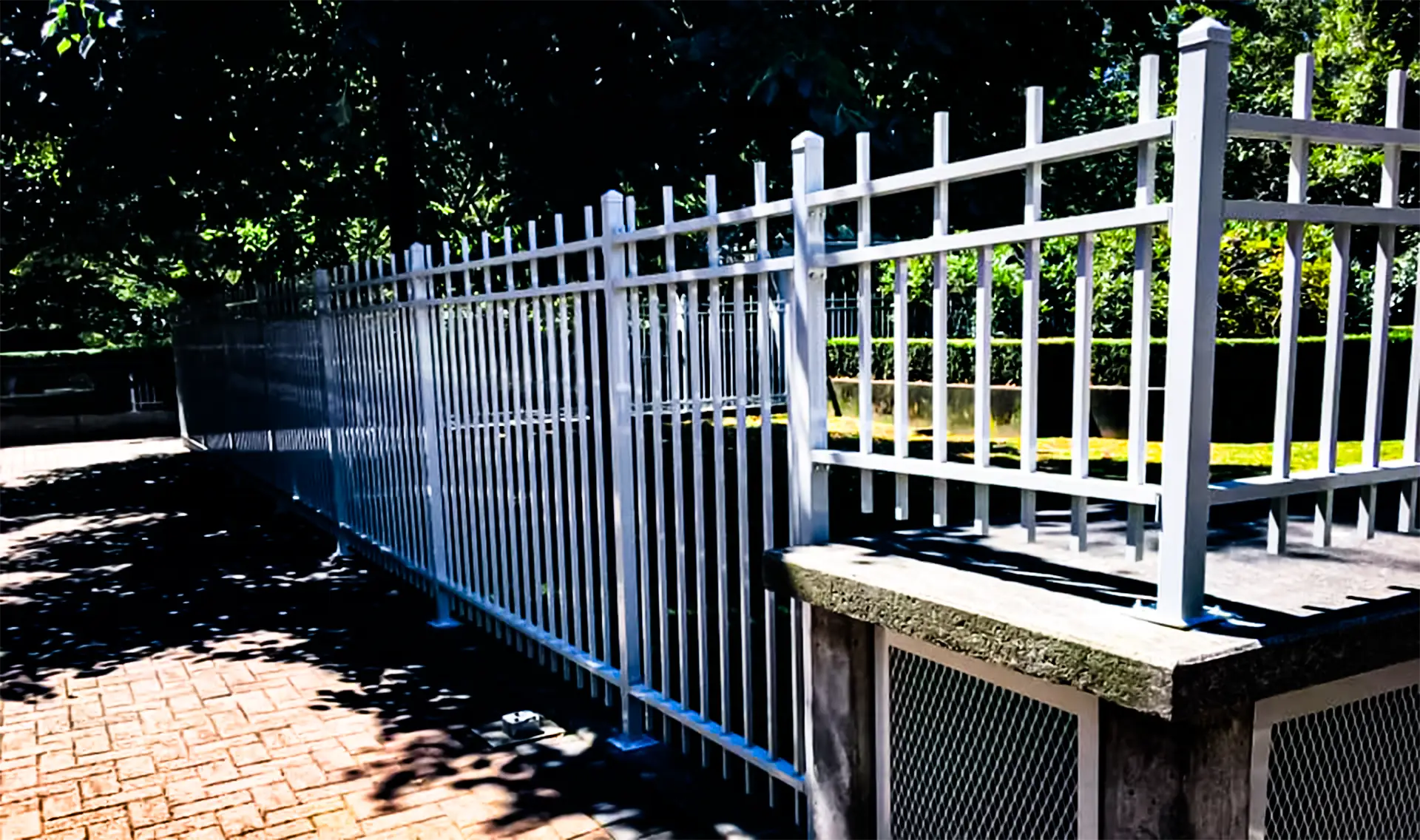
Aluminum generally handles wind best. Our ornamental aluminum fencing uses open pickets with space between them, so wind passes through instead of pushing against it, and the material is light relative to what it can resist. Powder-coated aluminum also shrugs off salt air, a bonus in White Rock and Tsawwassen.
Wood depends on style more than material. A solid board-on-board privacy fence presents a near-unbroken wall to the wind and carries the highest load of any common residential style, though the right design and installation can still make it work on an exposed lot.
Vinyl sits close to wood. A solid privacy vinyl fence catches roughly the same wind load as a solid wood panel of the same height, even with some engineered flex built in. A lattice-top or semi-privacy design cuts that load considerably.

Open vs. solid
As a general rule in the fencing trade, a solid privacy panel faces meaningfully more wind load than an open picket or semi-privacy design of the same height, because wind load scales with solid surface area.
Fence styles that cut wind load
Material is only half the equation, style matters just as much and is often the more cost-effective lever to pull.
Semi-privacy and shadowbox designs alternate or space boards, keeping most of a privacy look while letting some wind through, a real reduction in strain compared to a gapless panel.
Lattice-top panels trim the solid area at the top of the fence, right where wind speed and leverage on the posts are highest.
Ground clearance of even an inch or two at the bottom gives wind somewhere to escape instead of loading the full panel.
Chain link is the most wind-permeable style available, and a solid option in its own right for backyard security, dog runs, or commercial enclosures. Our chain link fencing holds up well on exposed sites for exactly this reason.

One more thing: gates. A gate is usually the largest solid panel on a fence line and swings on hinges, so it takes the brunt of wind loading. Treat gate posts as a special case, not an afterthought, on any windy property.
Installation details that matter in a storm
On most storm-damaged fences we’re called out to repair, the material wasn’t the problem, the installation wasn’t built for the site’s actual wind exposure.
Post depth. A common baseline is roughly a third of the post’s total length set below grade. On an exposed coastal or outflow-prone property, that’s a starting point, posts often need to go deeper to resist uplift and rotation.
Concrete footings. A footing wider at the bottom than the top resists being pulled or rotated out of the ground far better than a straight-sided footing of the same depth, and footing size should scale up with height and exposure.
Post spacing. Tighter spacing, more posts along the run, spreads wind load across more anchor points and reduces leverage on each one.
Post material and gauge. Heavier-gauge steel or reinforced aluminum posts hold up more consistently than standard wood posts over years of exposure, especially at corners, ends, and gates.
A fence with shallow post depth, undersized footings, or standard spacing on an exposed lot can look fine for months and fail all at once in the first real outflow or coastal storm. Flag your site’s exposure to your contractor before installation, not after a panel has come down.
Which fence is right for your property
On an exposed coastal lot in Tsawwassen, White Rock, or Point Grey, or a Fraser Valley property in an outflow corridor, an open ornamental aluminum fence is usually the safest starting point for wind performance, with a well-detailed semi-privacy or shadowbox design as a strong second choice where privacy is the priority.
On a more sheltered lot, a traditional solid wood or vinyl privacy fence is still a fine choice. Proper post depth, footing size, and spacing matter on every fence we install, windy site or not.
The right call comes down to the specific site, which direction it faces and what’s blocking or funnelling wind around it. That’s why we walk every property in person before quoting a wind-exposed job.
Open designs (aluminum picket, chain link, semi-privacy) handle Metro Vancouver’s coastal and outflow winds better than solid privacy panels, but installation quality matters just as much as the material you choose.
Frequently Asked Questions
What’s the most wind-resistant fence material for Metro Vancouver?
Aluminum ornamental fencing generally performs best in high wind. Its open picket design lets wind pass through instead of pushing against it, a strong choice for exposed sites in Tsawwassen, White Rock, and Point Grey.
Can vinyl fencing handle the wind in exposed areas?
Yes, but style matters more than material. A semi-privacy or lattice-top design sheds wind far better than a solid panel, and solid privacy vinyl can still work with deeper posts and larger footings.
Will a wood privacy fence blow down in a windstorm?
Not necessarily, but it’s the highest-risk style without proper installation. A solid cedar privacy fence has the most surface area of any common style, so it depends heavily on post depth, footing size, and spacing.
How deep should fence posts be set on a windy property?
Deeper than standard practice, and it depends on the site. A common baseline is roughly a third of the post length below grade, but exposed or outflow-prone properties often need posts set deeper with wider footings.
Does Fortress Fencing repair fences damaged by wind or storms?
Yes, fence repairs are one of our core services. We’ve seen what wind exposure does to under-built fences across Surrey and the Fraser Valley, and can assess whether a damaged section needs a repair or a rebuild.
Is Your Fence Built for the Wind?
We’ll walk your site and quote a fence engineered for Surrey and Greater Vancouver conditions, where safety meets style.